Back to Overview
02
From Rules to Intelligence

AI & Machine Learning Platform

Betfred's data platform has been migrated from SQL Server to Amazon Redshift, creating the foundation for advanced analytics. This initiative builds an enterprise ML platform on top of that foundation, transforming rule-based processes into intelligent, self-learning systems across five high-impact use cases.

Current State Assessment

Where Betfred Stands Today: Rules, Not Intelligence

Betfred's current operations rely on rule-based systems, manual processes, and batch analytics. While the Redshift migration provides the data infrastructure, the analytical capabilities remain limited to retrospective reporting rather than predictive intelligence.

Capability Gap Analysis

Capability
Current Approach
Gap
Status
Fraud Detection
Rule-based system with manual thresholds
Cannot detect novel patterns, multi-accounting, or coordinated fraud rings
Rule-Based Only
KYC Verification
Manual document review (avg. 48 hours)
Slow onboarding, high dropout rate, inconsistent quality
Manual Process
Responsible Gambling
Self-exclusion lists + basic deposit limits
Reactive only — intervenes after harm, not before
Rule-Based Only
Personalisation
Segment-based promotions (5 broad segments)
Generic offers, low conversion, wasted marketing spend
Rule-Based Only
Odds Optimisation
Static margin models, manual trader adjustments
Slow to react to market shifts, leaving value on the table
Manual Process
Data Analytics
SQL Server reports (migrated to Redshift)
Batch-only, no real-time insights, limited ML capability
Rule-Based Only
AML Compliance
Periodic batch screening
Delayed detection, regulatory risk, manual SAR filing
Rule-Based Only
Customer Churn
No predictive capability
Reactive retention — only acts after customer leaves
No Capability
Cost of Staying Rule-Based
£2.4M
Annual fraud losses
48 hrs
KYC verification time
35%
KYC dropout rate
£825K+
Regulatory fine risk
Before & After

Data Platform Transformation: Toggle to Compare

Switch between Betfred's current analytics stack and the proposed AI/ML platform to see the transformation.

Interactive Architecture View
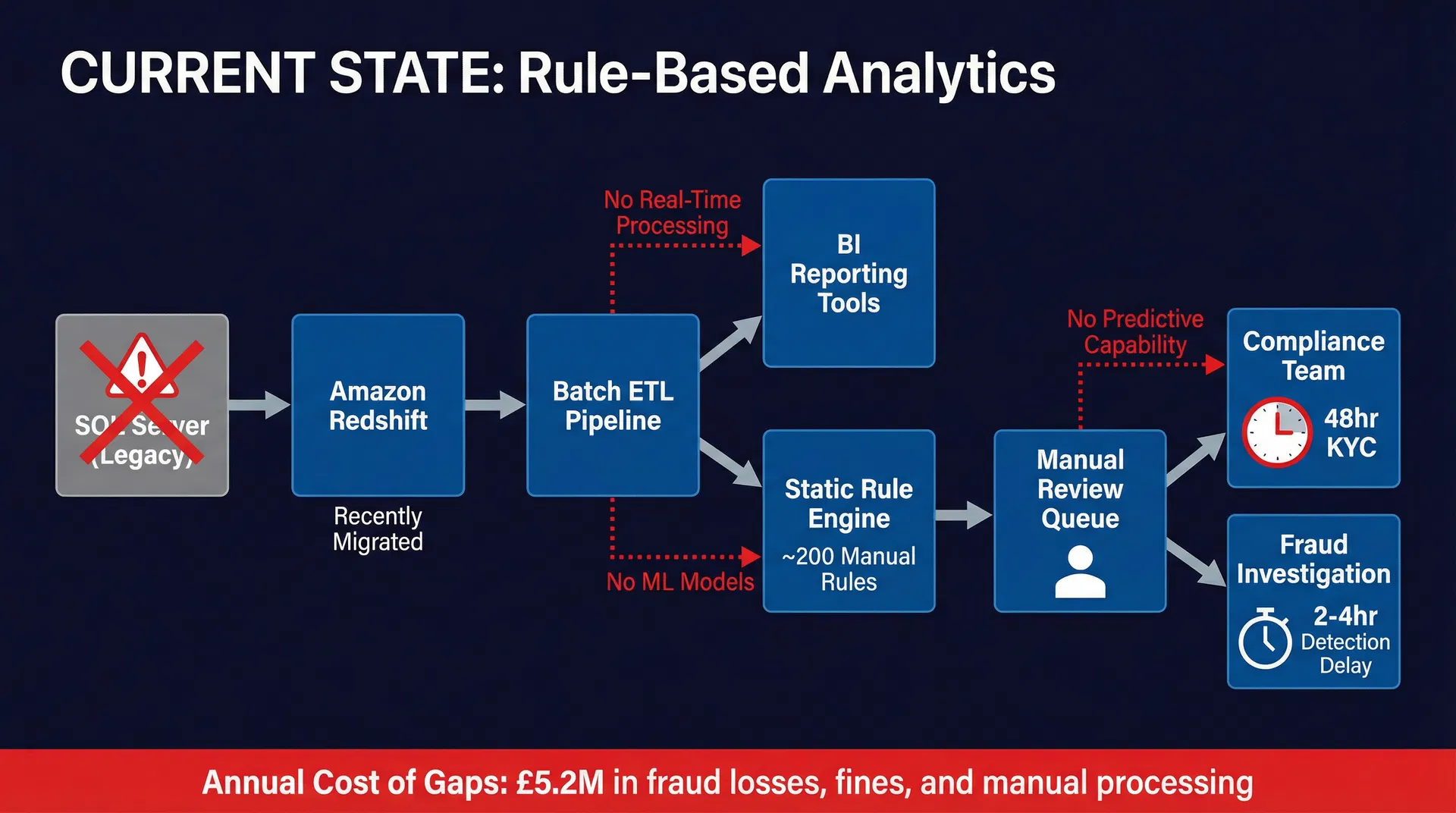
Current: Batch Analytics on Redshift
🗄️
Redshift
Data warehouse, batch queries
📊
BI Reports
Retrospective dashboards
📋
Rule Engine
Static rules, manual thresholds
👤
Manual Review
Human-in-the-loop for decisions
📝
Batch Output
Daily/weekly reports only
CURRENT PAIN POINTS
Fraud detected 2–4 hours after occurrence (batch processing)
KYC takes 48 hours with 35% customer dropout
Generic promotions — same offer for all customers in segment
No predictive capability for responsible gambling
Manual trader adjustments — reactive to market, not predictive
Compliance relies on periodic batch screening
Financial Case

Total Cost of Ownership: Current vs. AI Platform

Annual Operational Cost Comparison

Cost CategoryRule-Based (Current)AI/ML Platform (Future)Annual Saving
Fraud LossesRule-based detection → real-time ML scoring£2,400,000£960,000£1,440,000
KYC Manual Review Team6 FTE reviewers → 1 FTE for edge cases only£360,000£60,000£300,000
Regulatory Fine RiskReactive compliance → proactive ML monitoring£825,000£50,000£775,000
Marketing WasteBroad segments → individual-level targeting£1,200,000£720,000£480,000
AWS SageMaker InfrastructureTraining + inference compute, Feature Store£0£420,000-£420,000
ML Engineering Team4 ML engineers + 1 MLOps engineer£0£480,000-£480,000
Manual Trader AdjustmentsManual odds management → ML-assisted£280,000£80,000£200,000
Compliance ReportingManual SAR filing → automated generation£180,000£40,000£140,000
Total Annual Cost£5,245,000£2,810,000£2,435,00046% reduction

Net Annual Value

Including £4.2M revenue uplift from personalisation and odds optimisation, the total annual value exceeds £6.6M.

£2.4M
Cost Savings
£4.2M
Revenue Uplift
£6.6M
Total Annual Value
Implementation Detail

Five Use Cases: Current State → Future State

Each use case shows where Betfred is today, what the ML-powered future looks like, the specific models involved, and the business value delivered.

01

Responsible Gambling & Player Protection

Critical Priority
Current State

Self-exclusion lists and basic deposit limits. Compliance team manually reviews flagged accounts. Reactive intervention only.

Future State

Real-time behavioural anomaly detection using LSTM autoencoders on session data. Proactive intervention before harm occurs.

Behavioural Anomaly Detector

ModelLSTM Autoencoder
FeaturesSession duration, bet frequency, deposit velocity, loss-chasing patterns
Latency< 200ms

Risk Score Predictor

ModelXGBoost Classifier
Features30-day behavioural features, deposit/withdrawal ratio, time-of-day patterns
Latency< 50ms

Churn-to-Harm Classifier

ModelLightGBM
FeaturesEngagement decline + spending increase correlation
Latency< 100ms
Risk ScoreRisk LevelAutomated Action
0–30LowStandard monitoring, no intervention
31–60MediumSoft nudge: 'Take a break?' messaging, cooling-off suggestion
61–80HighMandatory cooling-off period, reduced deposit limits, compliance alert
81–100CriticalAccount suspension, compliance review, UKGC notification
Business Value:Avoid £825K+ regulatory fines, protect vulnerable players
02

Hyper-Personalisation & CLV Optimisation

High Priority
Current State

5 broad customer segments with generic promotional offers. Same bonus for all customers in a segment. Low conversion rates.

Future State

Individual-level propensity models predicting next-best-action for each customer. Dynamic offer generation based on real-time behaviour.

CLV Predictor

ModelDeep Neural Network
FeaturesLifetime deposit/withdrawal, product mix, session frequency, tenure
Latency< 100ms

Next-Best-Action Engine

ModelMulti-Armed Bandit
FeaturesReal-time context, historical response, channel preference
Latency< 50ms

Churn Predictor

ModelGradient Boosted Trees
FeaturesEngagement decay, deposit frequency change, support interactions
Latency< 80ms
Business Value:25% revenue lift, 40% improvement in marketing ROI
03

Fraud Detection & Prevention

Critical Priority
Current State

Rule-based fraud system with ~200 static rules. Manual investigation queue. 2–4 hour average detection time for new fraud patterns.

Future State

Real-time ML scoring on every transaction. Graph neural networks for multi-accounting detection. Automated case management.

Transaction Scorer

ModelIsolation Forest + XGBoost
FeaturesAmount, velocity, device fingerprint, geo-location, time patterns
Latency< 30ms

Multi-Account Detector

ModelGraph Neural Network
FeaturesDevice sharing, IP correlation, payment method overlap, betting patterns
Latency< 500ms

Bonus Abuse Classifier

ModelRandom Forest
FeaturesWagering patterns, withdrawal timing, account age, referral chains
Latency< 50ms
Business Value:60% reduction in fraud losses, 80% faster detection
04

Automated KYC & AML Compliance

High Priority
Current State

Manual document review averaging 48 hours. 35% customer dropout during verification. Periodic batch AML screening.

Future State

AI-powered 12-second verification pipeline. OCR + facial matching + sanctions screening in a single automated flow.

Document OCR Engine

ModelVision Transformer (ViT)
FeaturesPassport, driving licence, utility bill extraction
Latency< 3s

Facial Comparison

ModelArcFace CNN
FeaturesSelfie vs. document photo, liveness detection
Latency< 2s

AML Risk Scorer

ModelEnsemble (RF + GBT)
FeaturesPEP lists, sanctions, adverse media, transaction patterns
Latency< 5s
Business Value:94% auto-approval rate, 12-second average verification
05

Dynamic Odds Optimisation

Medium Priority
Current State

Static margin models with manual trader adjustments. Traders react to market movements rather than anticipating them.

Future State

ML models predicting market movements and automatically adjusting odds within trader-defined guardrails.

Market Movement Predictor

ModelTemporal Fusion Transformer
FeaturesHistorical odds, volume, social sentiment, team news
Latency< 200ms

Margin Optimiser

ModelReinforcement Learning
FeaturesCompetitive odds, customer elasticity, exposure limits
Latency< 100ms
Business Value:15–20% accuracy boost, improved margin management
Data Pipeline

Redshift → SageMaker: Leveraging Your Investment

The SQL Server to Redshift migration created the data foundation. This pipeline extends it into a full ML platform, with Redshift as the feature engineering source feeding SageMaker for model training and real-time inference.

Data Sources
Redshift (transactional)Kinesis (real-time events)S3 (historical archives)DynamoDB (session data)
Feature Engineering
SageMaker Feature StoreSpark on EMR (batch)Kinesis Analytics (stream)Feature versioning
Model Training
SageMaker Training JobsHyperparameter TuningMLflow Experiment TrackingDistributed Training
Model Serving
SageMaker EndpointsAuto-Scaling (HPA)A/B TestingShadow Deployment
Monitoring
Model Monitor (drift)CloudWatch MetricsBusiness KPI TrackingAutomated Retraining

Training Infrastructure

Training Compute
ml.p3.8xlarge (4x V100 GPUs)
Feature Store
SageMaker Feature Store (online + offline)
Experiment Tracking
MLflow on EKS
Model Registry
SageMaker Model Registry
Retraining Frequency
Weekly (batch) + triggered (drift)
Data Volume
~2TB daily from Redshift

Inference Infrastructure

Real-Time Endpoints
ml.m5.xlarge (auto-scaled)
Batch Transform
ml.m5.4xlarge for nightly scoring
Latency Target (p99)
< 100ms for real-time models
Throughput
10,000 predictions/sec sustained
A/B Testing
SageMaker traffic splitting
Fallback Strategy
Rule-based system if model unavailable

Future Solution: What Betfred Will See

End-State Vision

AI Platform Dashboard

Centralised command centre showing all five ML models, their health status, prediction volumes, drift metrics, and business KPIs. Operators can view model performance trends, trigger retraining, and manage A/B experiments from a single interface.

Projected Business Impact

£6.6M
Total Annual Value
60%
Fraud Loss Reduction
94%
KYC Auto-Approval Rate
12s
Average KYC Time