Unified Sportsbook API Gateway
Betfred's sportsbook currently relies on RabbitMQ as the message broker for 40+ gaming provider data feeds. While RabbitMQ delivers reliable AMQP messaging, it was never designed to be an API management platform. This initiative charts the evolution from RabbitMQ to Tyk, consolidating message brokering, API governance, security, and analytics into a single platform with zero disruption.
RabbitMQ: Betfred's Integration Backbone Today
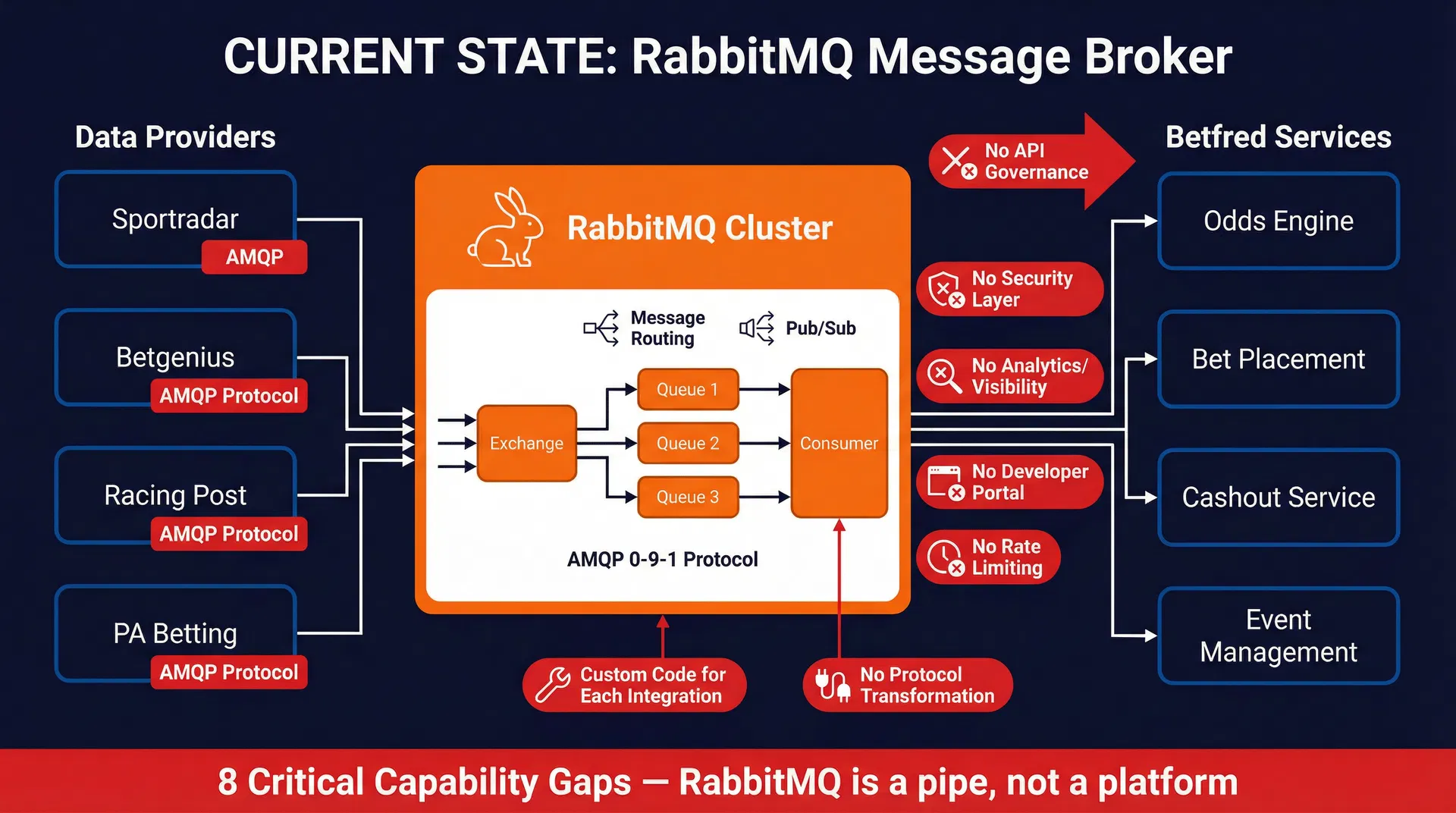
RabbitMQ serves as the central message broker for sportsbook data ingestion. Providers like Sportradar, Betgenius, and SIS publish odds feeds over AMQP 0-9-1, which RabbitMQ routes to internal consumer services via exchanges and queue bindings. This architecture has served Betfred well for reliable message delivery, but it leaves critical gaps that limit the platform's ability to scale, govern, and optimise.
Current Data Flow
What RabbitMQ Does Well
The Gaps: What RabbitMQ Cannot Provide
From RabbitMQ to Tyk: One Platform, Zero Disruption
Tyk Streams natively supports AMQP 0-9-1, the same protocol RabbitMQ uses. This means Tyk can directly consume from sportsbook providers, perform message routing, transformation, and fan-out, while simultaneously providing API governance, security, analytics, and a developer portal. One platform replaces two, eliminating an entire infrastructure component.
Capability Comparison
Future State Data Flow
Tyk Streams natively supports AMQP 0-9-1 input/output connectors. This means Tyk can directly consume from the same providers that currently publish to RabbitMQ, eliminating the need for a separate message broker entirely.
How Tyk Streams Replaces RabbitMQ
Tyk Streams AMQP Configuration
# Tyk Streams - Direct AMQP Consumer
input:
  amqp_0_9:
    urls:
      - amqp://sportradar:5672
      - amqp://betgenius:5672
    queue: betfred.odds.live
    consumer_tag: tyk-gateway
    prefetch_count: 100

pipeline:
  processors:
    - mapping: |
        root.event_id = this.eventId
        root.market = this.market
        root.odds = this.selections
        root.provider = meta("amqp_routing_key")
        root.timestamp = now()

output:
  http_client:
    url: https://api.betfred.internal/odds
    verb: POST
    headers:
      Authorization: "Bearer ${JWT_TOKEN}"
      Content-Type: application/json
What This Enables
Tyk Streams connects directly to provider AMQP endpoints, consuming odds feeds without an intermediary broker.
Messages are transformed to the canonical data model within the stream pipeline, no custom consumer code required.
A single AMQP input can fan out to HTTP REST, WebSocket, SSE, and gRPC consumers simultaneously.
All stream processing inherits Tyk's security policies, rate limiting, analytics, and audit logging.
Three-Phase Migration: RabbitMQ to Tyk
The migration is designed to be progressive and zero-disruption. Phase 1 adds governance without changing existing flows. Phase 2 progressively migrates provider feeds. Phase 3 decommissions RabbitMQ entirely.
Governance Layer
Months 1 to 3Tyk deployed alongside RabbitMQ. Connects to existing queues as a consumer. Immediate visibility, security enforcement, and analytics without touching existing data flows.
Key Deliverables
Provider Migration
Months 4 to 8Provider feeds progressively migrated from RabbitMQ to Tyk Streams direct AMQP consumption. Tyk Streams natively supports AMQP 0-9-1, enabling direct provider connection.
Key Deliverables
Decommission
Months 9 to 12All 40+ provider feeds running on Tyk Streams. RabbitMQ fully decommissioned. Single platform for all API management, event streaming, and data governance.
Key Deliverables
Tyk Hybrid Deployment Architecture
Tyk Gateway deployed in hybrid mode: control plane in Tyk Cloud for management, data plane on Betfred's AWS infrastructure (eu-west-2) for data sovereignty and sub-5ms latency.
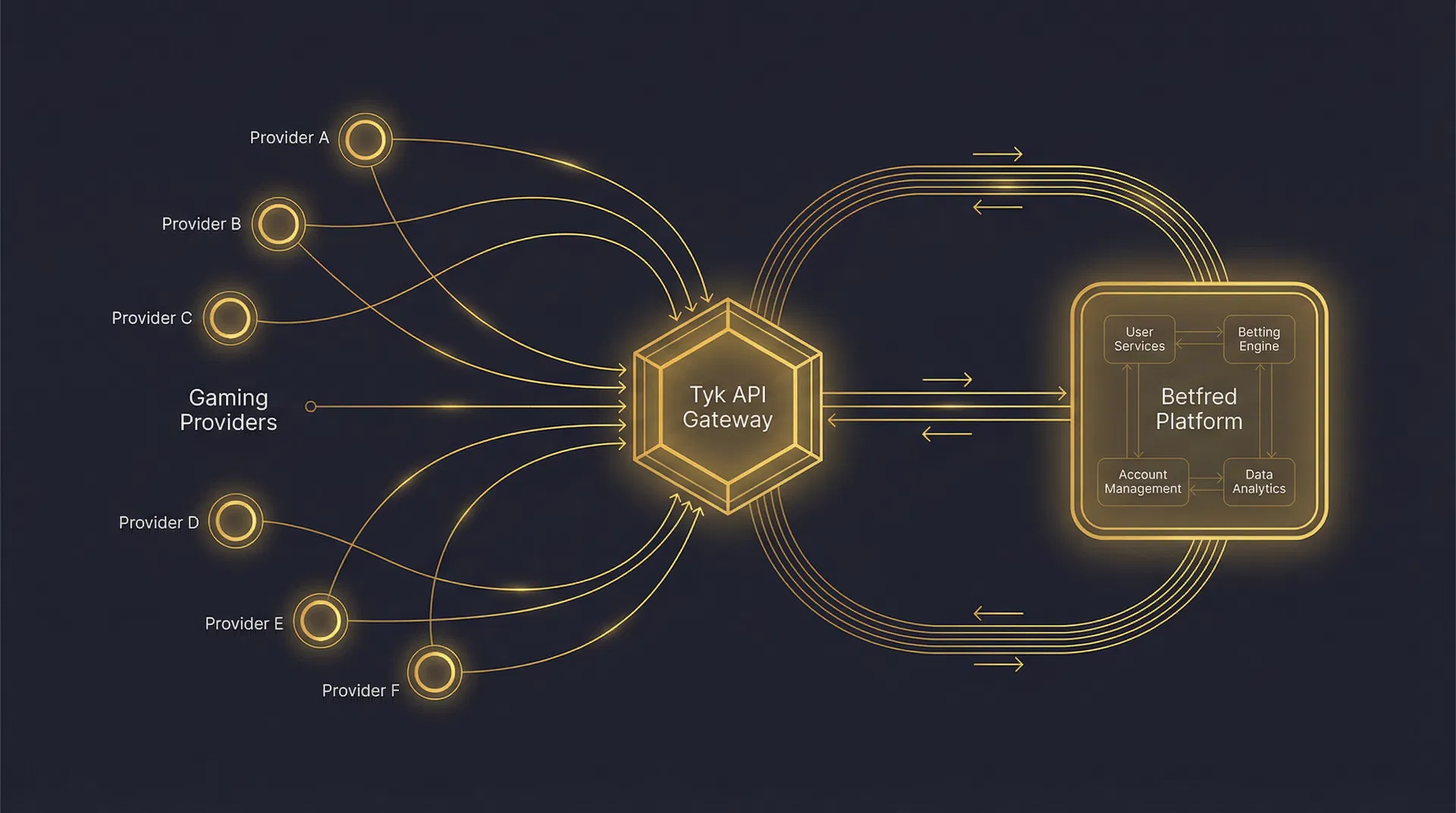
Request Flow: Sportsbook Data Ingestion via Tyk
Implementation Specifications
Gateway Performance Targets
Deployment Configuration
Rate Limiting Tiers
Tyk Streams Configuration
Why Tyk: Competitive Analysis
Tyk was selected after evaluating it against Kong, AWS API Gateway, Apigee, and MuleSoft for Betfred's sportsbook requirements. The critical differentiator is Tyk Streams, which provides native AMQP support that eliminates the need for RabbitMQ entirely.
| Criterion | Tyk + Streams | Kong | AWS API GW | RabbitMQ (Current) |
|---|---|---|---|---|
| AMQP Native Support | Yes (Tyk Streams) | No (plugin) | No | Yes (core) |
| API Management | Full platform | Full platform | Limited | None |
| Deployment Flexibility | Hybrid (cloud + on-prem) | Hybrid | Cloud-only | Self-hosted only |
| Open Source Core | Yes (Apache 2.0) | Yes (Apache 2.0) | No | Yes (MPL 2.0) |
| GraphQL/UDG Support | Native Universal Data Graph | Plugin-based | Limited | None |
| Streaming + API in One | Yes (unified) | No (separate) | No | Streaming only |
| Developer Portal | Built-in | Separate product | Limited | None |
| UK Data Residency | Full control | Full control | AWS regions only | Full control |
Architecture Transformation: Toggle to Compare
Switch between Betfred's current RabbitMQ architecture and the proposed Tyk future state to see the transformation at a glance.
Interactive Architecture View
Total Cost of Ownership: RabbitMQ vs. Tyk
A direct comparison of annual operational costs between maintaining the current RabbitMQ infrastructure with custom integration code versus the proposed Tyk unified platform.
Annual Operational Cost Comparison
| Cost Category | RabbitMQ (Current) | Tyk Platform (Future) | Annual Saving |
|---|---|---|---|
| Message Broker InfrastructureRabbitMQ cluster: 6 nodes, HA config, monitoring | £180,000 | £0 | £180,000 |
| Tyk Gateway + Streams LicenceTyk Enterprise hybrid deployment | £0 | £240,000 | -£240,000 |
| Custom Integration Code4 FTE developers maintaining bespoke parsers → 0.5 FTE config | £480,000 | £60,000 | £420,000 |
| Provider Onboarding Labour8–12 weeks per provider → 3–5 days via portal | £320,000 | £80,000 | £240,000 |
| Incident Response & FailoverManual failover + on-call → automated circuit breakers | £150,000 | £30,000 | £120,000 |
| Monitoring & ObservabilityCustom dashboards → built-in Tyk analytics | £90,000 | £0 | £90,000 |
| Security & ComplianceManual audit + basic auth → automated policy enforcement | £120,000 | £25,000 | £95,000 |
| Infrastructure OverheadSeparate broker infra → consolidated platform | £75,000 | £45,000 | £30,000 |
| Total Annual Cost | £1,415,000 | £480,000 | £935,00066% reduction |
Net Annual Saving
After accounting for Tyk Enterprise licence costs, Betfred saves £935K annually while gaining capabilities that RabbitMQ cannot provide.
Future Solution: What Betfred Will See
End-State Vision
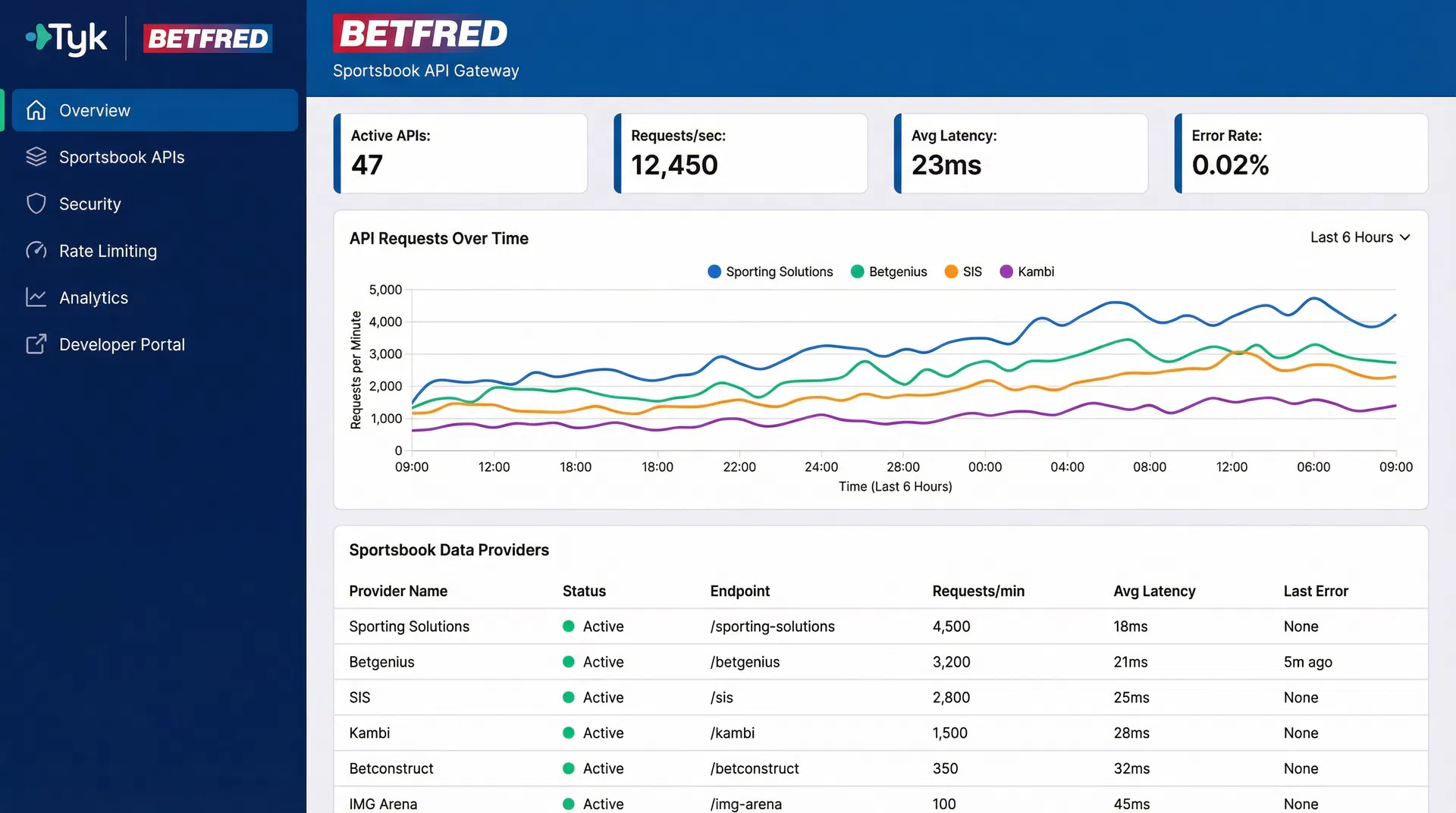
API Gateway Dashboard
Real-time operational dashboard showing all 40+ provider integrations, per-provider latency heatmaps, error rates, and throughput metrics. Operators can drill down into individual provider health, view circuit breaker states, and manage rate limiting tiers from a single pane of glass.